
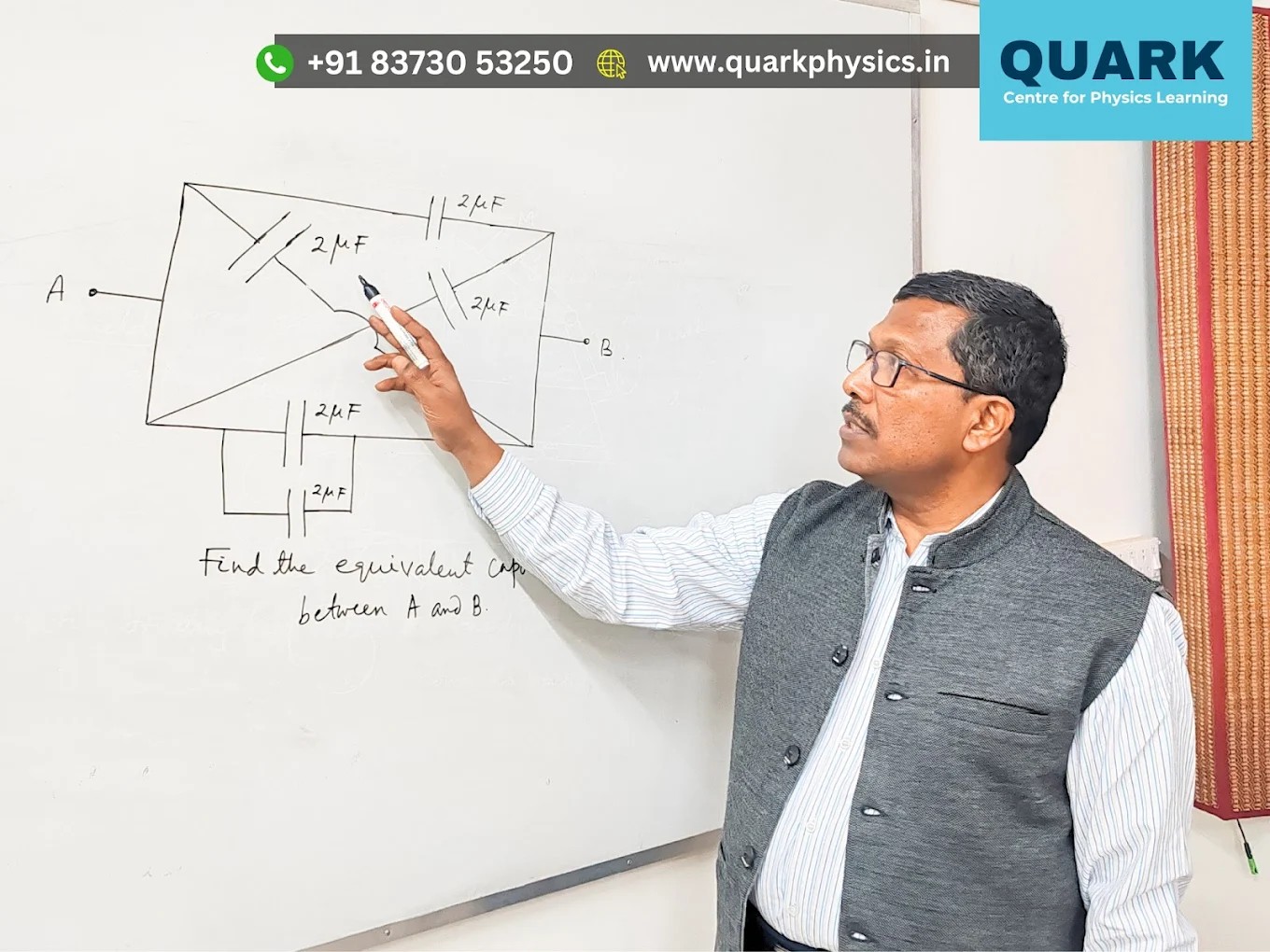
The short answer is — mostly yes, but critically no. And the difference is not just about which chapters you study. It is about how deeply you study them, how questions are framed, and what kind of thinking the examiner expects from you.
If you are a student in Kolkata deciding between a medical or engineering path — or if you are the parent of one — this guide will help you understand where the syllabi overlap, where they differ, and how to plan your preparation.
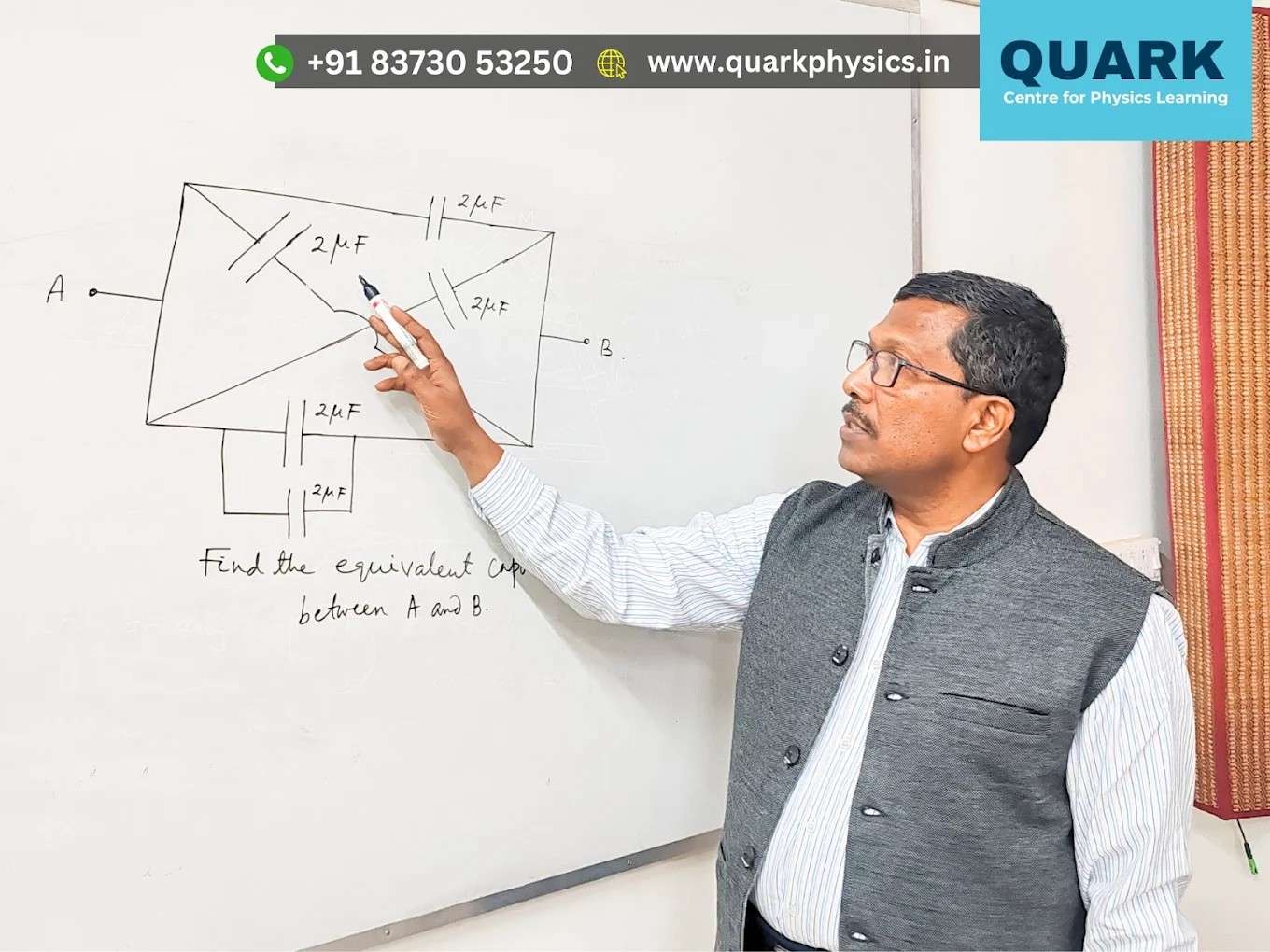
At Quark Centre for Physics Learning in Kolkata, students receive guidance focused on conceptual clarity, systematic problem-solving, and exam-oriented practice. Let us explore the differences between NEET Physics and JEE Physics.
Are You Preparing for NEET or JEE?
Are you preparing for NEET, JEE, or still undecided? At Quark Centre, a Physics coaching institute in Kolkata led by Sisir Sir, we help students build a strong foundation for their target examinations.
Book a free demo class to understand our approach to learning Physics.
Call us: 8373 053 250
Visit: Contact Quark Centre
The Big Picture: How Much Do NEET and JEE Physics Syllabi Actually Overlap?
Students and parents often assume that since NEET and JEE Physics are based on Class 11 and Class 12 Physics, the syllabi are identical. Although they share many topics, the exact syllabus and depth of coverage differ.
- NEET Physics: Focuses on conceptual understanding, accurate calculations, formula application, and preparation based on the prescribed syllabus.
- JEE Main Physics: Covers many of the same foundational topics but may include more demanding numerical problems and multi-step applications.
- JEE Advanced Physics: Requires deeper conceptual understanding, analytical thinking, and the ability to combine multiple Physics concepts in one problem.
NEET Physics and JEE Main Physics share substantial syllabus content. However, studying the same chapter does not mean preparing for both examinations in exactly the same way. Always consult the official syllabus for your examination year.
Chapter-by-Chapter Comparison: NEET Physics vs JEE Main Physics vs JEE Advanced
Class 11 Physics Chapters
- Units and Dimensions: Important for understanding physical quantities, dimensional analysis, and measurement-related concepts.
- Kinematics: Covers motion in one and two dimensions, projectile motion, and relative motion. JEE questions may involve more complex applications.
- Laws of Motion: Focuses on Newton's laws, friction, and their applications. JEE Advanced may require more elaborate reasoning.
- Work, Energy, and Power: Covers work-energy relationships and conservation of energy. JEE problems may combine these concepts with rotational motion.
- System of Particles and Rotational Motion: Includes centre of mass, torque, angular momentum, and moment of inertia. This area can be particularly challenging in JEE Advanced.
- Gravitation: Includes gravitational force, potential, and satellite motion.
- Properties of Solids and Fluids: May include elasticity, viscosity, and surface tension, depending on the prescribed syllabus.
- Thermodynamics: Covers thermodynamic processes, heat, work, and the laws of thermodynamics.
- Kinetic Theory of Gases: Focuses on the molecular interpretation of gases and related physical quantities.
- Oscillations and Waves: Covers simple harmonic motion, wave motion, and related concepts. Check the current syllabus for the exact scope.
Class 12 Physics Chapters
- Electrostatics: Includes electric charges, electric fields, potential, capacitance, and Gauss's law where prescribed.
- Current Electricity: Covers electric current, resistance, circuit laws, and electrical measurements.
- Moving Charges and Magnetism: Includes magnetic forces and the motion of charged particles in magnetic fields.
- Electromagnetic Induction and Alternating Currents: Covers induced EMF, Faraday's law, inductance, and AC circuits.
- Ray Optics and Wave Optics: Includes reflection, refraction, lenses, optical instruments, and wave-optics concepts according to the syllabus.
- Dual Nature of Radiation and Matter: Covers the photoelectric effect and matter waves.
- Atoms and Nuclei: Includes atomic models, energy levels, radioactivity, and nuclear physics concepts.
- Electronic Devices and Semiconductors: Topic coverage varies by examination and syllabus year. Confirm the official syllabus before planning preparation.
Topics That May Differ Between NEET, JEE Main, and JEE Advanced
Some topics may be included in one examination but excluded or treated differently in another. Because official syllabi can change, students should verify the relevant examination-year documents.
- Communication Systems: Check the latest official syllabus before treating this as an examination topic.
- Magnetism and Matter: Verify the inclusion of specific magnetic properties and related concepts in the current syllabus.
- Semiconductors and Electronic Devices: Check whether diodes, logic gates, transistors, and related concepts are included in your target examination.
- Electromagnetic Waves: Compare the prescribed topics and depth of coverage for each examination.
Practical advice: Do not skip any topic based on an older syllabus or an unofficial chapter list. Use the official syllabus for your target examination year.
Topics That Are More Difficult in JEE Than in NEET
The chapters may overlap, but the depth and style of questions can differ significantly.
Rotational Motion
- NEET: Standard moment-of-inertia calculations and direct applications of angular momentum conservation.
- JEE Main: Multi-step problems involving rotation, translation, and rolling motion.
- JEE Advanced: More challenging problems combining rigid-body motion, collisions, and several mechanics concepts.
Electrostatics
- NEET: Electric fields, potential, point charges, and standard capacitor problems.
- JEE Main: Problems involving multiple charges, conductors, and electric flux.
- JEE Advanced: More complex problems requiring several electrostatic principles to be applied together.
Optics
- NEET: Lens and mirror formulas, refraction, prisms, and standard wave-optics problems.
- JEE Main: Optical instruments, lens combinations, and numerical applications.
- JEE Advanced: More demanding optical-system problems involving detailed reasoning.
Thermodynamics
- NEET: Basic thermodynamic processes, PV diagrams, and applications of the first law.
- JEE Main: Numerical questions involving processes, work, and efficiency.
- JEE Advanced: More complex thermodynamic cycles and conceptual problems.
Modern Physics
- NEET: Photoelectric-effect formulas, atomic energy levels, and nuclear-decay calculations.
- JEE Main: Numerical problems combining concepts from modern Physics.
- JEE Advanced: More analytical questions requiring deeper understanding and multi-step reasoning.
NEET Physics often rewards accuracy, efficient formula application, and familiarity with the prescribed syllabus. JEE Physics, particularly JEE Advanced, places greater emphasis on analytical thinking and combining multiple concepts.
The Question Style Difference: NEET vs JEE Physics
NEET Physics Questions
- Often test one main concept at a time, although some questions require multiple steps.
- Reward accurate formula selection, conceptual understanding, and careful calculation.
- Under the standard recent pattern, Physics contains 45 questions carrying 180 marks. Confirm the current information bulletin.
- Require thorough preparation of the prescribed syllabus and relevant NCERT material.
- The standard marking scheme awards four marks for a correct answer and deducts one mark for an incorrect answer, subject to the current rules.
JEE Main Physics Questions
- May involve multi-step numerical and conceptual problems.
- Can include multiple-choice and numerical-value questions, depending on the current paper pattern.
- Require efficient problem-solving under time pressure.
- Question counts and marking rules should be checked in the official information bulletin.
JEE Advanced Physics Questions
- Often require several Physics concepts to be applied together.
- May use different formats, including multiple-correct and numerical-answer questions, depending on the year.
- Reward analytical thinking and a deep understanding of formulas and their assumptions.
- The question pattern and marking scheme can vary annually.
Can You Prepare for Both NEET and JEE Physics Simultaneously?
Preparing for NEET and JEE Main Physics together can be possible because the syllabi overlap substantially. The key is to build a common foundation and then adapt your practice to each examination.
- Build the NCERT foundation first: Develop a clear understanding of the prescribed Class 11 and Class 12 Physics topics.
- Add depth for JEE: Practise more challenging problems in Rotational Motion, Electrostatics, Optics, and Thermodynamics.
- Focus on NEET accuracy: Revise formulas, solve previous-year questions, and practise timed tests.
- Plan separately for JEE Advanced: Allocate additional time to complex Mechanics and Electrodynamics problems, guided by the current syllabus.
At Quark Centre in Kolkata, our Physics learning options help students build fundamentals and prepare according to their examination goals.
Explore our Complete Physics Course and JEE Physics course to learn more.
Quick Reference: NEET vs JEE Physics Syllabus
The following table is a general study-planning reference. It is not a substitute for the official syllabus. Confirm every topic against the documents for your examination year.
| Chapter / Topic | NEET | JEE Main | JEE Advanced |
|---|---|---|---|
| Units and Dimensions | Verify syllabus | Verify syllabus | Verify syllabus |
| Kinematics | Verify syllabus | Verify syllabus | Verify syllabus |
| Laws of Motion | Verify syllabus | Verify syllabus | Verify syllabus |
| Work, Energy, and Power | Verify syllabus | Verify syllabus | Verify syllabus |
| Rotational Motion | Verify syllabus | Verify syllabus | Verify syllabus |
| Gravitation | Verify syllabus | Verify syllabus | Verify syllabus |
| Properties of Solids and Fluids | Verify syllabus | Verify syllabus | Verify syllabus |
| Thermodynamics | Verify syllabus | Verify syllabus | Verify syllabus |
| Kinetic Theory | Verify syllabus | Verify syllabus | Verify syllabus |
| Oscillations and Waves | Verify syllabus | Verify syllabus | Verify syllabus |
| Electrostatics | Verify syllabus | Verify syllabus | Verify syllabus |
| Current Electricity | Verify syllabus | Verify syllabus | Verify syllabus |
| Moving Charges and Magnetism | Verify syllabus | Verify syllabus | Verify syllabus |
| Magnetism and Matter | Verify syllabus | Verify syllabus | Verify syllabus |
| Electromagnetic Induction and AC | Verify syllabus | Verify syllabus | Verify syllabus |
| Ray Optics | Verify syllabus | Verify syllabus | Verify syllabus |
| Wave Optics | Verify syllabus | Verify syllabus | Verify syllabus |
| Dual Nature | Verify syllabus | Verify syllabus | Verify syllabus |
| Atoms and Nuclei | Verify syllabus | Verify syllabus | Verify syllabus |
| Semiconductors / Electronic Devices | Verify syllabus | Verify syllabus | Verify syllabus |
| Communication Systems | Verify syllabus | Verify syllabus | Verify syllabus |
| Electromagnetic Waves | Verify syllabus | Verify syllabus | Verify syllabus |
Which Chapters Should You Prioritise?
If You Are Targeting NEET Physics
- Electrostatics and Capacitors
- Moving Charges and Magnetism
- Ray Optics
- Modern Physics, including Atoms, Nuclei, and Dual Nature
- Thermodynamics
- Mechanics, including Laws of Motion and Work-Energy
- Electronic Devices, where included in the current syllabus
Study strategy: Start with the prescribed textbooks and clear conceptual notes. Then solve chapter-wise NEET previous-year questions, practise timed tests, and revise regularly.
If You Are Targeting JEE Main Physics
- Electrostatics and Current Electricity
- Ray Optics and Wave Optics
- Mechanics, including Kinematics, Laws of Motion, and Rotational Motion
- Modern Physics
- Thermodynamics
Study strategy: Combine concept revision with numerical practice, previous-year questions, and timed mock tests.
If You Are Targeting JEE Advanced Physics
- Mechanics
- Electrostatics and Electrodynamics
- Optics
- Thermal Physics
- Modern Physics
Study strategy: Master fundamentals, solve progressively challenging problems, and practise JEE Advanced previous-year questions. Do not skip topics without checking the official syllabus.
A Kolkata Perspective: What This Means for Students
Students in Kolkata may appear for WBJEE, JEE Main, and NEET in the same academic year. Preparing for more than one examination can be workable when the common Physics foundation is planned carefully and each exam's specific syllabus and question style are considered.
However, preparing for JEE Advanced and NEET simultaneously can be demanding. JEE Advanced requires substantial time for deeper problem-solving, while NEET preparation also requires consistent Biology and Chemistry study.
Our recommendation at Quark Centre is to identify your primary target by Class 11 while keeping other options in mind where appropriate. A clear preparation plan helps students manage their time and focus on the right skills.
If you need guidance, explore our Physics tuition in Kolkata for NEET and JEE.
Book a free demo class and speak with Sisir Sir.
Read more:
Frequently Asked Questions (FAQ)
1. Is NEET Physics and JEE Physics the same?
The syllabi overlap substantially because both draw on Class 11 and Class 12 Physics. However, the depth of study, question style, and some included topics differ. JEE Advanced generally requires more demanding multi-concept problem-solving. Always compare the official syllabi for the relevant year.
2. What is the difference between NEET and JEE Physics syllabus?
The main differences concern topic inclusion, depth, and question format. JEE Advanced typically places greater emphasis on analytical, multi-concept problems. Some topics may be included in one exam but excluded or treated differently in another, so use the current official syllabi.
3. Is NEET Physics easier than JEE Physics?
NEET Physics often uses more direct applications than JEE Advanced, which is known for deeper analytical problem-solving. However, difficulty varies by question and year, and scoring well in NEET remains challenging because of competition and the need for accuracy.
4. Can I prepare for NEET and JEE Physics together?
Yes, many students can prepare for NEET and JEE Main Physics together because the syllabi overlap substantially. Build a strong common foundation first, then practise according to each exam's question style. Combining NEET with intensive JEE Advanced preparation requires careful scheduling.
5. Which chapters are only in NEET Physics and not in JEE Advanced?
There is no permanent list because exam syllabi can change. Topics such as Communication Systems, Magnetism and Matter, and Electronic Devices have differed across syllabus versions. Check the official NEET and JEE Advanced syllabus for your target year.
6. How many questions are there in NEET Physics vs JEE Physics?
Under the standard recent pattern, NEET Physics has 45 questions for 180 marks. JEE Main Paper 1 includes Physics as one of three subjects. JEE Advanced consists of two papers, and its question formats and marking scheme can vary each year. Check the official information bulletins for your examination year.
7. Which books should I use for NEET Physics vs JEE Physics?
- NEET Physics: Prescribed NCERT textbooks, appropriate practice material, and previous-year questions.
- JEE Main Physics: NCERT for fundamentals, HC Verma where useful, topic-wise practice, and previous-year questions.
- JEE Advanced Physics: Strong conceptual resources, progressively challenging problem sets, and JEE Advanced previous-year questions.
8. Does Physics tuition in Kolkata cover both NEET and JEE Physics?
Quark Centre in Kolkata provides Physics learning options for students preparing for NEET and JEE. Students can explore available courses and ask which programme fits their target exam.
Whether you are in Salt Lake, New Town, Dum Dum, Lake Town, Baguihati, or Kestopur, enquire about available classes through the Quark Centre courses page.
9. When should I decide between NEET and JEE Physics preparation?
Ideally, identify your main target by the beginning of Class 11. Many foundational Physics topics overlap, so early study can keep options open. As you progress, narrow your plan according to your goals, the relevant exam syllabi, and the time required for other subjects.
Ready to Get Clarity on Your NEET or JEE Physics Preparation in Kolkata?
Quark Centre, led by Sisir Sir, offers Physics learning options for students preparing for NEET and JEE.
- NEET Physics courses for Class XI-XII
- JEE Main and JEE Advanced Physics coaching in Kolkata
- Chapter-wise finishing classes
- Foundation courses for Class IX-X students
- Online and offline learning options
- Study materials for NEET and JEE preparation
Quark Centre reports student achievements including NEET AIR 2238, IISER AIR 50, and 100/100 in Madhyamik Physics. Contact the centre for further details about courses and student results.
Stop guessing. Start preparing the right way.
Book your FREE Demo Class: Contact Quark Centre
Explore all our courses: View Courses

 quark740@gmail.com
 8373 053 250