You have just entered Class 11. Your CBSE school has handed you a Physics textbook. And somewhere at the back of your mind — or perhaps very loudly at the front — is a single goal: NEET.
Here is the truth that most students in Kolkata find out too late: Class 11 is not a warmup year for NEET. It is the foundation year. Nearly 45 to 50 percent of every NEET Physics paper comes directly from your Class 11 syllabus. Laws of Motion, Thermodynamics, Waves, Gravitation — these chapters will appear in your NEET paper whether you take it next year or the year after. The students who score 160+ in NEET Physics are almost always those who took Class 11 seriously from day one.
This guide is your complete, start-to-finish NEET Physics preparation roadmap as a CBSE Class 11 student in Kolkata. It covers what to study, when to study it, how CBSE and NEET Physics align, what the biggest mistakes are — and how Quark Centre for Physics Learning helps students navigate every stage of this journey with expert guidance. If you want to understand the broader coaching landscape first, read our guide on best physics tuition in Kolkata.
Starting Class 11 this year? This is the right time to build your NEET Physics foundation.
Quark Centre's Class XI NEET Physics Course is structured to cover your CBSE board syllabus and NEET preparation simultaneously — so you never study the same chapter twice for two different exams.
Book a Free Demo Class or call +91 8373 053 250
Why Class 11 Is the Most Important Year for NEET Physics
Most CBSE students in Kolkata make a critical mistake: they treat Class 11 as a year to "get familiar" with Physics and reserve serious effort for Class 12. This thinking costs them dearly in NEET.
Here is what the data actually shows. Based on NEET 2025 paper analysis, Class 11 Physics chapters contributed nearly 45 percent of the total Physics questions. Chapters like Laws of Motion, System of Particles and Rotational Motion, Thermodynamics, and Oscillations and Waves appear every single year — not occasionally, but consistently. These are Class 11 chapters. If you do not master them now, you will be trying to relearn them in Class 12 while simultaneously handling Electrostatics, Current Electricity, Optics, and Modern Physics. That is an impossible juggling act.
The second reason Class 11 matters so deeply is conceptual continuity. Class 12 Physics does not restart — it continues. Electrostatics builds on your understanding of force and field concepts from Mechanics. Electromagnetic Induction builds on your knowledge of magnetic effects, which connects to your understanding of circular motion and energy. A student who has genuinely mastered Class 11 Physics finds Class 12 Physics logical and connected. A student who rushed through Class 11 finds Class 12 overwhelming and disconnected.
At Quark Centre, Sisir Sir dedicates the first six to seven months of the Class XI programme entirely to building this conceptual foundation — not because the chapters are hard, but because a strong foundation in Class 11 makes everything that follows dramatically easier.
How CBSE Class 11 Physics and NEET Physics Align — Chapter by Chapter
One of the biggest advantages of being a CBSE student preparing for NEET in Kolkata is that NEET Physics is 100 percent based on the NCERT syllabus — the same textbook your CBSE school uses. This means you are not studying two different syllabi. You are studying one subject at two levels of depth.
Here is how the Class 11 chapters map to NEET Physics, along with their exam weightage:
Tier 1 — Highest Weightage Class 11 Chapters
Laws of Motion — Newton's three laws, friction, circular motion, and free body diagrams appear in almost every NEET paper. This chapter is the single most important chapter in Class 11 for NEET Physics. Questions are conceptual, numerical, and often deceptively simple. Students who truly understand this chapter score consistently.
Work, Energy and Power — Conservation of energy, work-energy theorem, and power problems are regularly tested. This chapter is closely linked to Laws of Motion and should be studied immediately after it.
System of Particles and Rotational Motion — One of the highest-weightage Class 11 chapters. Centre of mass, torque, angular momentum, and moment of inertia questions appear consistently. This chapter is difficult for many students — which means it is a scoring opportunity for those who master it.
Thermodynamics — First and second laws, Carnot cycle, isothermal and adiabatic processes are tested regularly. CBSE students often find this chapter theory-heavy, but NEET makes it numerical. Understanding the underlying principles is critical.
Oscillations and Waves — Simple harmonic motion, damped oscillations, wave motion, and the Doppler effect are tested frequently. This chapter connects strongly to several Class 12 topics including sound and optics.
Tier 2 — Medium Weightage Class 11 Chapters
Kinematics — Motion in a straight line and motion in a plane (projectile motion, relative motion) are foundational. Questions from this chapter are usually straightforward but require numerical accuracy.
Gravitation — Universal law of gravitation, escape velocity, orbital speed, and Kepler's laws appear in NEET with moderate frequency. Relatively short chapter with high return on time invested.
Properties of Bulk Matter — Elasticity, viscosity, surface tension, and Bernoulli's theorem are tested occasionally. Do not skip this chapter, but do not over-invest time either.
Kinetic Theory of Gases — Closely related to Thermodynamics. Mean free path, RMS speed, and degrees of freedom are tested. Study this alongside Thermodynamics for maximum efficiency.
Tier 3 — Foundation Chapters
Physical World and Measurement and Units and Dimensions — These chapters are important for CBSE boards and provide the mathematical language of all Physics that follows. NEET questions from these are usually limited to 1 to 2, but the concepts underpin everything else.
At Quark Centre, the Class XI NEET Physics course is structured around exactly this priority framework — spending maximum time on Tier 1 chapters while covering Tier 2 and Tier 3 with appropriate depth and efficiency.
Month-by-Month NEET Physics Preparation Roadmap for Class 11 in Kolkata
Here is a practical, month-by-month roadmap specifically designed for CBSE Class 11 students in Kolkata, accounting for your school schedule, half-yearly exams, and annual board exams.
Phase 1 — Foundation Building
This is your most important phase. You have the most time, the least exam pressure, and the opportunity to build the conceptual framework that everything else will rest on.
What to study: Start with Units and Dimensions, then move to Kinematics, followed by Laws of Motion and Work-Energy-Power. Do not rush. Spend three to four weeks on Laws of Motion alone if needed. Understand every concept from the NCERT textbook before picking up any additional reference book.
How to study: Read the NCERT chapter first. Understand the derivations — not to memorise them, but to understand the physical reasoning behind each step. Then solve all NCERT solved examples and exercises. Only after completing NCERT should you attempt additional numericals from books like H.C. Verma for conceptual depth.
What not to do: Do not start with a reference book. Do not skip chapters you find "boring." Do not move to the next chapter before you can solve any problem from the previous one without looking at notes.
How Quark Centre helps in Phase 1: Sisir Sir's approach during Phase 1 is deliberately slow and deep. Classes focus on building physical intuition — why does a body remain at rest? What does friction actually do? This approach, though it feels unhurried, is what prevents the gaps that most students discover painfully in Class 12. View the full course structure on the NEET Physics course page.
Phase 2 — Core Chapter Completion
By August, your school schedule will be picking up pace. Half-yearly exams typically fall around September or October for most CBSE schools in Kolkata. This phase requires you to balance school and NEET preparation without letting either suffer.
What to study: Rotational Motion, Gravitation, Properties of Bulk Matter, Thermodynamics, Kinetic Theory of Gases, and Oscillations and Waves. These are the remaining high and medium weightage Class 11 chapters.
Study strategy: Study Thermodynamics and Kinetic Theory of Gases together — they are conceptually linked. Study Oscillations first, then Waves — SHM provides the mathematical framework for wave motion. For Rotational Motion, make a separate formula sheet and revise it every three days during this phase.
Testing: By September, you should be doing chapter-wise tests after completing each chapter. A minimum of 25 to 30 NEET-pattern MCQs per chapter before moving ahead. This is non-negotiable. Quark Centre conducts regular chapter-wise tests as part of its standard course structure — students receive detailed error analysis, not just scores. If you need focused test practice on specific chapters, our Chapter Wise Finishing Classes are ideal for this phase.
Revision: By the time you start a new chapter in Phase 2, you should be spending 20 to 30 minutes every third day revising Phase 1 chapters. Without this, you will forget 60 percent of what you studied in Phase 1 by the time your NEET exam arrives.
Phase 3 — Consolidation and Mock Practice
December to March is when most Kolkata CBSE students face their annual board practical examinations and begin pre-board preparation. This is also when NEET preparation often gets abandoned — which is precisely why students who maintain consistency during this phase gain a significant advantage.
What to study: You should now be revising Class 11 chapters, not learning them. Complete any pending chapters from Phase 2. Begin a structured revision of all Class 11 Physics chapters — one chapter every three to four days, focusing on weak areas identified during chapter tests.
Mock tests: Start attempting full NEET Physics section mocks (45 questions, 60 minutes). Analyse every mistake. Not just the wrong answers — also the right answers you guessed or took too long on. Both represent gaps.
Board + NEET alignment: The good news for CBSE students is that your board Physics paper and NEET Physics preparation are largely aligned. Board questions test the same concepts at a slightly lower difficulty level. A student who has genuinely prepared for NEET will comfortably score 90+ in their CBSE board Physics paper without separate board-specific preparation.
Quark Centre's curriculum is explicitly designed around this alignment. Sisir Sir ensures that every chapter covered during NEET preparation is simultaneously board-exam ready — students do not need two separate study programmes. This is a key reason why students from CBSE schools across Salt Lake, Newtown, Baguihati, Dum Dum, and Kestopur choose Quark Centre over generic multi-subject coaching.
The Quark Centre Advantage — Why Physics-Only Coaching Makes a Difference for NEET
When a CBSE Class 11 student in Kolkata joins a multi-subject coaching centre for NEET, Physics typically gets two to three hours per week among five subjects. At Quark Centre, Physics gets everything.
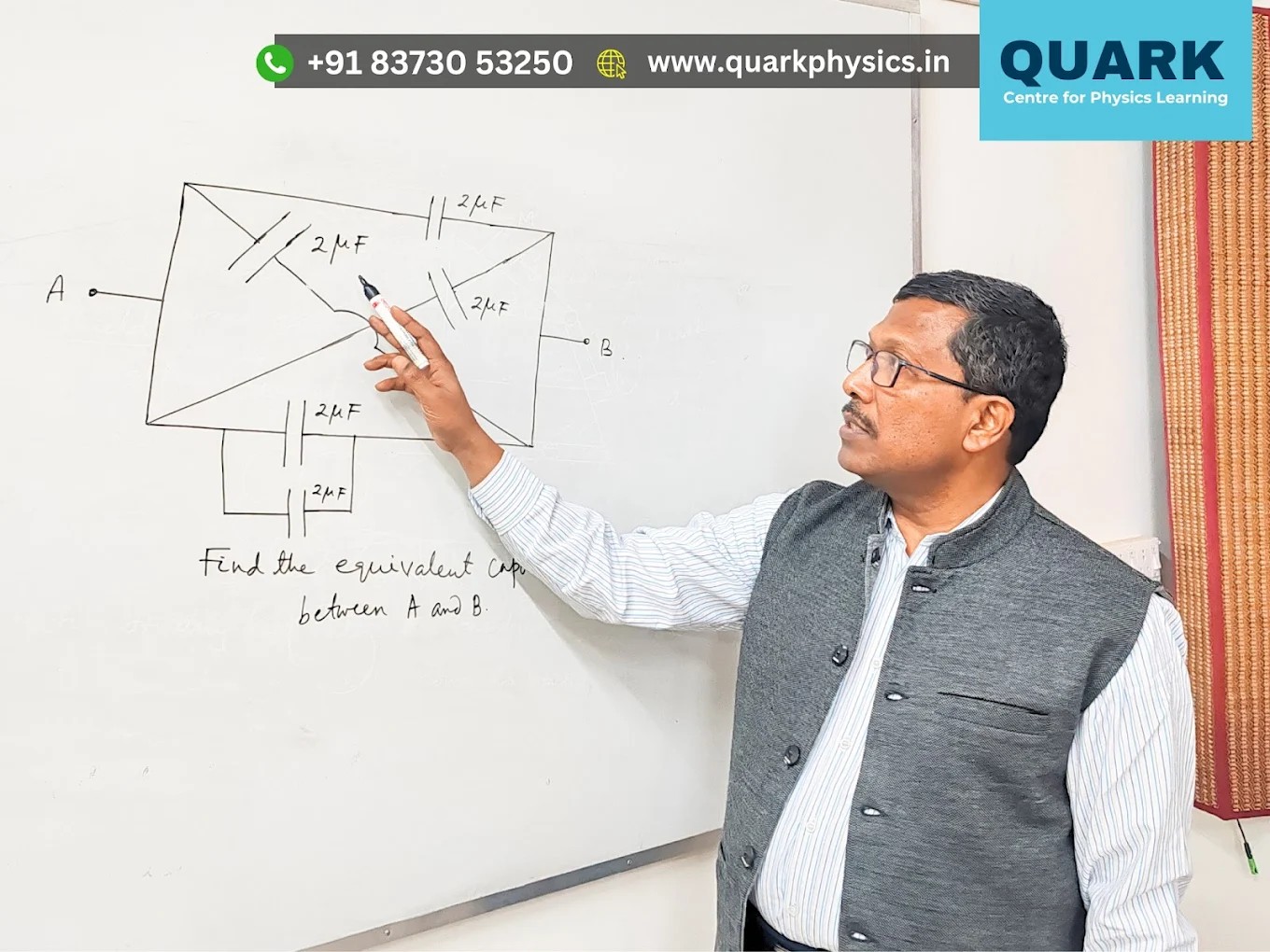
Led by Sisir Sir (M.Sc, Calcutta University) with over 20 years of dedicated Physics teaching experience, Quark Centre is Kolkata's only Physics-specialist institution that covers NEET, JEE, WBJEE, and board Physics under one roof. Here is what that means in practice for a Class 11 NEET student:
Deeper concept coverage: Because Sisir Sir teaches only Physics, every class goes further into the "why" behind each concept — not just the "what." This is the difference between a student who can solve textbook problems and a student who can solve the tricky conceptual MCQs that appear in NEET.
NEET-pattern study material: Quark Centre's proprietary 4-module Physics study material is built around NEET and JEE exam patterns, not generic textbook content. It includes NEET-style MCQs, previous year questions organised chapter-wise, and numerical practice sets aligned with NTA's testing framework.
Doubt clearing that actually works: In a 30-student multi-subject batch, your doubt about projectile motion competes with someone else's doubt about organic chemistry. At Quark Centre, every doubt is a Physics doubt — addressed fully, not squeezed into the last five minutes of class.
Flexible online and offline options: Whether you live in Salt Lake, Newtown, Rajarhat, or anywhere across West Bengal, Quark's live online classes give you full access to Sisir Sir's teaching without the Kolkata commute. Explore all options on the courses overview page.
Academic credibility that is verifiable: Sisir Sir's teaching has been endorsed by Associate Professor Kaushik Das (University of Maryland Eastern Shore) and Full Professor Rajesh Mahadevan (University of Concepcion). Read more about Sisir Sir's background on the About Us page.
Common Mistakes CBSE Class 11 Students Make in NEET Physics Preparation
Mistake 1 — Starting with Reference Books Instead of NCERT
H.C. Verma and D.C. Pandey are excellent books — but only after NCERT is complete. NEET Physics questions are NCERT-based. A student who has thoroughly understood every NCERT concept and solved every NCERT exercise is already prepared for 70 percent of what NEET Physics will ask. Reference books provide the remaining 30 percent. Students who reverse this order end up confused, overwhelmed, and behind.
Mistake 2 — Ignoring Numerical Practice
NEET 2025 saw a significant increase in numerical-type Physics questions compared to previous years. CBSE students who only study theory and skip numericals consistently underperform in NEET Physics. Every chapter requires daily numerical practice — not just reading solved examples, but attempting unseen problems independently.
Mistake 3 — No Revision System
Studying a chapter once and moving on is not preparation — it is reading. Revision must be built into your schedule from Phase 1. A chapter you studied in April and never revisited will be essentially forgotten by November. Use a simple spaced repetition system: revise every chapter once after two weeks, once after a month, and once every six weeks thereafter.
Mistake 4 — Treating NEET and Board Prep as Separate
As a CBSE student, your NEET Physics syllabus and board Physics syllabus are the same. Treating them as two separate preparation tracks wastes time and creates anxiety. The right approach — which Quark Centre has structured its entire curriculum around — is to prepare for NEET Physics at full depth, which automatically prepares you for boards at a comfortable level.
Mistake 5 — Waiting Until Class 12 to Take Coaching Seriously
The students who score 150+ in NEET Physics in Class 12 are almost always those who started structured coaching in Class 11. By the time a Class 12 student joins coaching, Tier 1 Class 11 chapters like Laws of Motion and Rotational Dynamics are already supposed to be mastered. Trying to learn them fresh while simultaneously handling Class 12 chapters is the most common reason for NEET Physics scores in the 80 to 100 range instead of 140 to 160.
Frequently Asked Questions
1. Is NEET Physics the same as CBSE Class 11 and 12 Physics?
Yes. NEET Physics is 100 percent based on the NCERT Class 11 and Class 12 syllabus, which is the same curriculum CBSE students follow. The difference is the level of application — NEET tests concepts through tricky MCQs and numerical problems rather than the straightforward questions in CBSE board exams. This is why studying NCERT thoroughly is essential, but coaching that goes deeper than NCERT is equally important.
2. How many hours should a Class 11 student study Physics for NEET daily?
In Phase 1 (April to July), 1.5 to 2 hours of focused Physics study daily is sufficient if the time is genuinely productive — NCERT reading, solved examples, and independent numerical practice. Quality matters more than quantity. By Phase 2 and Phase 3, 2 to 2.5 hours daily including revision is appropriate.
3. Which Class 11 Physics chapters are most important for NEET?
The highest-priority chapters for NEET from Class 11 are Laws of Motion, Work-Energy-Power, Rotational Motion, Thermodynamics, and Oscillations and Waves. These chapters together account for the majority of Class 11's contribution to the NEET Physics paper. None of them should be taken lightly.
4. Can I prepare for both CBSE boards and NEET Physics simultaneously in Class 11?
Yes — and this is exactly what you should do. The CBSE board and NEET Physics syllabus are the same. Preparing for NEET Physics at full depth automatically covers your board syllabus. Quark Centre's Class XI NEET Physics course is structured to achieve both goals through a single, well-integrated programme.
5. Is online Physics coaching for NEET effective for Class 11 students in Kolkata?
Yes, provided it is live, interactive, and structured — not just recorded videos. Quark Centre's online classes are fully live with real-time doubt clearing, regular chapter tests, and the same study material as offline batches. Students from Newtown, Rajarhat, Baguihati, and other areas across Kolkata attend Quark's online sessions and receive the same quality of instruction as students in the physical classroom. See all batch options on the courses page.
6. When should I start NEET Physics coaching as a Class 11 student in Kolkata?
The ideal time is at the very beginning of Class 11 — April or May. Starting at this point gives you a full two-year preparation window. Students who start in July or August of Class 11 can still build a strong foundation, but they will need to move faster through the early chapters. Starting in Class 12 is possible, but it requires significantly more intensive effort to cover Class 11 gaps alongside Class 12 content.
7. What study material does Quark Centre provide for NEET Physics in Class 11?
Quark Centre provides a 4-module proprietary Physics study material set designed specifically for NEET and JEE preparation. It includes chapter-wise theory notes, solved NEET-pattern MCQs, previous year questions, and numerical practice sets aligned with the NTA exam format. It is available as part of the course enrollment and also for separate purchase.
8. Does Quark Centre offer Physics coaching for Class 9 students aspiring for NEET?
Yes. For students who want to begin even earlier, Quark Centre's Class IX–X Foundation Course builds the mathematical and conceptual foundation for both NEET and JEE Physics — giving students a head start that compounds significantly by Class 11.


 quark740@gmail.com
 8373 053 250